To write a letter to your therapist, say who you are, name the one thing you most want them to know, give a little context, describe how it feels, and finish with what you would like from them. Keep it to a page, write the way you speak, and decide whether to send it ahead, read it aloud in session, or bring it along. Four short example letters are below to borrow from.
Why people write letters to their therapist
Therapy is often one hour a week or less, and a lot has to fit into it. A letter lets you say the important thing without finding the words under pressure.
- Some things are hard to say out loud. Shame, anger, grief or a thought you have never voiced can stall in your throat. On paper you can take your time.
- Sessions are time-limited. It is easy to spend forty minutes on the week's small events and realise the real issue is still unsaid.
- Your mind goes blank. Many people arrive with plenty to say and lose it once the session starts. A letter is a memory aid you can hold.
- You want to be understood accurately. Editing lets you say what you mean rather than what comes out in the moment.
Send it, read it, or bring it along
None of these is the correct choice. Pick what feels safest and what your therapist is comfortable with.
Send it before the session
This works when you want your therapist to have read and thought about it first. It can save time and make a difficult topic feel less sudden. The catch is that not every therapist reads messages between sessions, so ask first.
Read it aloud in session
If speaking is the hard part, a prepared letter gives you a script. Your therapist can respond in real time. Some people read all of it. Others read the first paragraph and then find they can talk freely.
Bring it along without committing
Arrive with the letter in your bag and decide in the room. You might hand it over, read part of it, or just use it as a prompt for yourself. If you want help deciding what to share and what to keep, see how to share mental health notes with your therapist.
A simple five-part structure
You do not need a formula, but a loose structure stops a letter becoming a wall of text. Try one to three sentences for each part.
- Open with where you are. "I am writing this because I find it hard to say things in the moment."
- Say the main thing. Put the one point you most want understood near the top so it does not get buried.
- Give a little context. What has been happening, or one concrete example.
- Describe how it feels. Emotions, body sensations, thoughts you keep returning to. You do not need to justify them.
- Say what you would like. Help, a question, a change in how sessions go, or simply to be heard. "I am not sure what I need yet" is a valid ending.
If you are unsure what your main point is, what to say to your therapist and what to talk about in therapy offer ideas.
Four example letters
These are original and deliberately short. Change the details to fit your life.
Example 1: Before a first session
Hi [name],
I am nervous about starting, so I wrote this down. The main reason I am here is that I have felt on edge for a few months and cannot work out why. Work is busy, but it does not feel like only work.
I sleep badly, I snap at people I care about, and then I feel guilty. I have never done therapy before and I am not sure what is normal to share.
I would like a sense of how this works and some help understanding what is going on. If I go quiet, it is not that I do not want to be here. I just freeze sometimes.
Thank you, [your name]
For more on that first meeting, see first therapy session: what to expect.
Example 2: Something hard to say
Hi [name],
There is something I have been circling for weeks and have not been able to say. I think I will say it better on paper.
I keep feeling that I am a burden to my family. It has been getting louder, and I feel ashamed even writing it.
I am afraid you will react badly, or that it will change how you see me. I would like to talk about it today, and it would help if we could go slowly.
[your name]
If your letter involves thoughts of harming yourself, please do not wait for the next session. Contact your therapist urgently, a crisis line, or local emergency services in your country.
Example 3: An update between sessions
Hi [name],
A quick update before Thursday. I tried the breathing exercise we talked about. It helped on two evenings but not on the third, after an argument with my sister.
My mood has been lower since the weekend, and I have been skipping lunch without meaning to. I do not think it is a crisis, but I wanted you to know.
I would like to spend time on why arguments with her hit so hard. I will bring a few notes.
[your name]
Example 4: Feeling stuck
Hi [name],
I want to be honest: I feel stuck. I like talking to you, but I am not sure I am changing. I keep repeating the same stories each week.
Part of me worries that I am not trying hard enough. Another part wonders if we need to do something differently.
Could we use some of this session to look at what we are working on and whether it still fits? I am saying this because I want therapy to work, not because I want to stop.
[your name]
If this one sounds familiar, how to tell your therapist it is not working goes into it further.
Tips on length and tone
- Aim for one page or less. Around 150 to 300 words is plenty. A short letter that gets read beats a long one that gets skimmed.
- Write like you talk. Plain, direct sentences are easier for both of you.
- Use "I" statements. "I feel dismissed when..." is clearer than a long account of what someone did.
- Be specific. One real example tells your therapist more than a general summary.
- Leave out what you are not ready for. The letter is yours.
For a fuller routine beyond letters, see how to prepare for a therapy session.
How your therapist may respond
Responses vary, and that is normal. Some therapists welcome letters, read them beforehand and refer back to them. Some prefer you read them in the room. Some do not read messages between sessions, or only at set times.
So ask before you send anything: "Is it okay if I write something down and send it before our session, or would you rather I bring it?" Also ask how quickly they read messages and whether they reply, so you are not left waiting.
If they read your letter, they may ask you to say more about one part, or let you take the lead.
When to get support
A letter is a way to communicate, not a substitute for urgent help. If you are in distress, having thoughts of harming yourself, or feel unsafe, contact a licensed mental health professional, local emergency services or a crisis line in your country right away. Do not wait for a session or a reply to a message.
Where Symplia fits
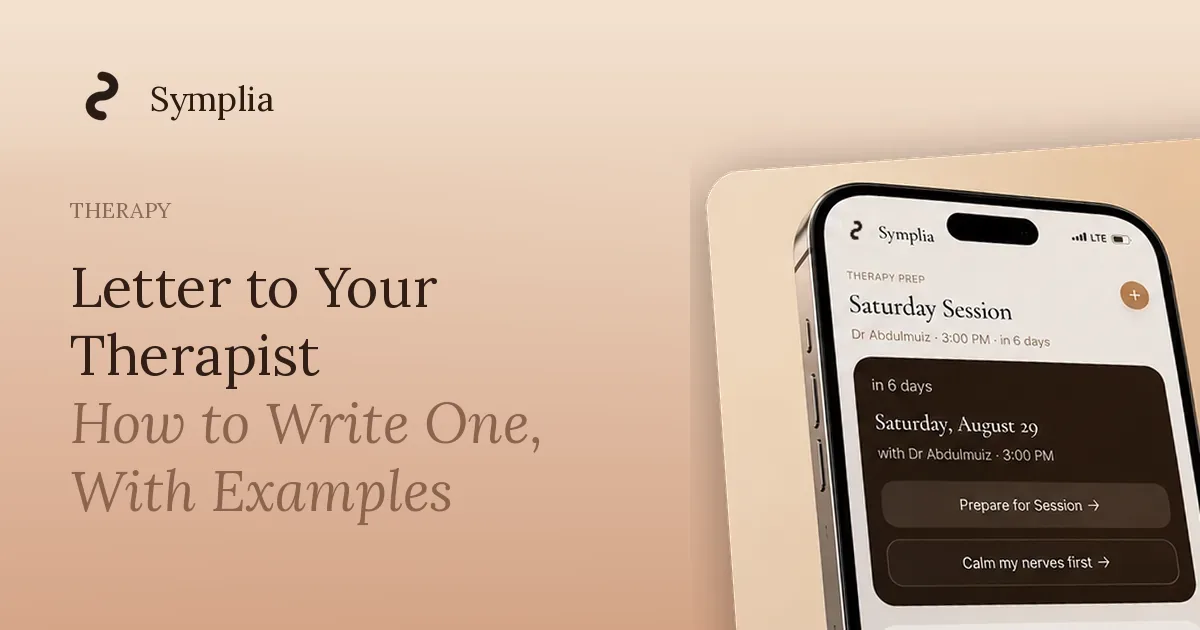
Symplia is a private mental health app for journaling, tracking and therapy support. Its Letter to Therapist feature gives you a place to put what you want to say, and Session Prep helps you organise what to bring. You choose what goes to your therapist. It can be used alongside therapy, but it is not therapy and does not replace a licensed professional. More on this is on the therapy session prep page.
Try Symplia free at app.symplia.app. Monthly and Annual plans include a 7-day free trial.
Frequently asked questions
Is it okay to write a letter to my therapist?
Yes. Many people find it easier to say difficult things in writing. Check with your therapist about how they like to receive letters or messages.
Should I send the letter before the session or bring it with me?
It depends on your therapist and on you. Sending it ahead gives them time to think, while bringing it lets you decide in the moment whether to read it, hand it over or keep it as a prompt.
How long should a letter to my therapist be?
Usually one page or less, around 150 to 300 words. Shorter letters are easier to respond to, and you can add more in session.
What if my therapist does not read messages between sessions?
That is a common policy and not a rejection. Bring the letter to the session, read it aloud or hand it over, and ask what they suggest for next time.
What if I cannot find the words to start?
Begin with "I find this hard to say, so I am writing it down." Then add one sentence about what you most want them to know.
Can a letter replace talking in session?
No. A letter opens the conversation, but the work still happens when you talk with your therapist.