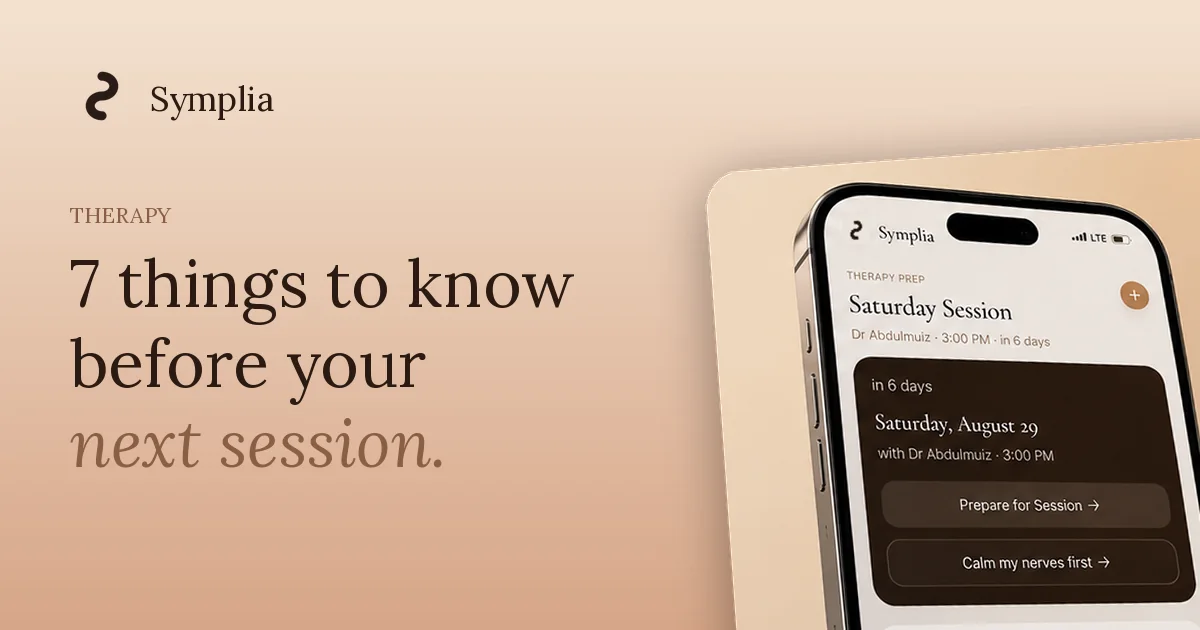
Before your next therapy session, the most useful things to know are that you do not need a perfect plan, that the week fades from memory faster than you expect, and that a few specific notes will help more than a long list. Spend ten minutes before you go writing down what stood out, what you have been avoiding, and one thing you want to be different. Then let your therapist guide the rest.
This is not a step-by-step checklist. If you want that, read our guide on how to prepare for a therapy session. This post is about the things worth understanding first, the ideas that make preparing feel lighter and sessions feel more useful.
1. You do not need a polished agenda
Many people skip preparing because they imagine it means arriving with a neat presentation. It does not. Therapists are used to clients who walk in unsure where to begin, and "I do not know where to start" is a normal opening.
What helps is a few raw notes, not a script. Three bullet points written on your phone are enough. They are there to remind you of what mattered, not to control the session.
2. The week fades faster than you think
By the time your appointment comes around, the sharp moments of the week have often softened. The argument on Tuesday feels smaller. The thought you had at 11pm is gone. This is normal memory, not a sign you did not care.
Because of this, the best preparation starts before the day of the session. When something stands out, write one line about it as it happens: a note, a voice memo, a journal entry. When you sit down before the session you are reviewing, not trying to remember.
3. One clear question beats five vague topics
A long list can make a session feel scattered. If you can, narrow it down to the one thing you most want help with, then keep a couple of others in reserve. Questions that work well include:
- "I keep reacting this way when X happens. What is going on there?"
- "I have been feeling flat for two weeks and I do not know why. Can we look at it?"
- "I want to talk about something I find hard to say."
Your therapist can still take the conversation elsewhere. Having one clear thread just makes sure the thing that matters to you is not lost.
4. The thing you are avoiding is usually worth raising
Almost everyone has something they would rather not bring up. It might be embarrassing, painful, or feel too small to mention. Often it is the most useful thing to talk about.
You do not have to say it perfectly or all at once. You can open with "There is something I have been avoiding and I am not sure how to start." A therapist can work with that. Writing it down beforehand makes it easier to say out loud.
5. Practical updates count
Therapists often find it helpful to know about sleep, appetite, energy, major events, changes in routine, and anything your prescriber or doctor has changed. These can feel too ordinary to mention, but they give context for how you have been feeling.
A quick note on how you have been sleeping and how your mood has moved across the week is often more informative than a long explanation. If you track your mood, bring the overall picture, not every data point.
6. You can talk about therapy itself
You are allowed to bring up how therapy is going. If you feel a session is not helping, if something your therapist said landed badly, or if you want a different pace or approach, saying so is part of the work. Good therapists want that feedback, and it often leads to a better fit.
A note such as "I want to talk about how our sessions are going" is enough to start. It is also a good reason to keep a short log of what felt useful and what did not.
7. Plan for the landing, not just the arrival
Preparation is not only about before. How you leave matters too. Many people walk out of a session with a realisation and lose it within hours.
Try to leave ten minutes after your appointment, even in a parked car or on a bench, to write down:
- the one or two things that stood out
- anything you want to try before the next session
- what you want to start with next time
That note becomes the start of your next preparation, so you are never beginning from nothing.
A ten-minute routine you can actually keep
If you want something simple, try this the evening before or an hour before your session:
- Read your notes from the week, including any mood entries or journal lines.
- Write down the one thing you most want to work on.
- Add one thing you have been avoiding, if there is one.
- Add a quick practical update on sleep, energy and anything that changed.
- Take two minutes to breathe and arrive without rushing.
That is enough. If you do this regularly, it builds into a record of your therapy that you can look back on.
Sharing with your therapist is your choice
Some people read their notes aloud, some hand over a short summary, and some use them privately and speak from memory. Any of these is fine. You decide what to share. If you want to learn more about turning notes into a conversation, see our guide on how to share your mental health journey with your therapist.
Where Symplia fits
Symplia is a private mental health app with a Therapy Session Prep tool. You can log what happens during the week, check in on your mood, and gather topics before an appointment, so you arrive knowing what you want to say. You choose what to share with your therapist, and Symplia does not replace therapy or a licensed professional. You can read more about therapy session prep on Symplia or look at therapy homework for keeping the work going between sessions.
Try Symplia free at app.symplia.app. Monthly and Annual plans include a 7-day free trial.
Frequently asked questions
How long before therapy should I start preparing?
Ideally you capture short notes through the week, then spend ten minutes before the session reviewing them. If you can only do one thing, do the ten minutes the evening before or an hour ahead.
What should I bring to my next therapy session?
A few notes on what stood out this week, one thing you want to work on, one thing you have been avoiding, and a quick update on sleep, mood and any changes. You can keep these on your phone or on paper.
What if I forget everything once I am in the room?
That happens often. Keep your notes with you and glance at them, or tell your therapist "I wrote some things down" and read from them. Most therapists welcome it.
Is it normal to have nothing to talk about?
Yes. You can say so. Sometimes that opens up a useful conversation about why you feel blank, or what the week has been like.
Do I have to share my journal with my therapist?
No. You choose what to share, if anything. Many people use their notes only to prepare.
Can I tell my therapist I want to change how we work?
Yes. Feedback about pace, approach or fit is a normal part of therapy and often improves it.