Session prep is a short preparation you do before a therapy appointment: a few minutes spent noting how you have been since your last session, what you most want to work on, and anything your therapist should know. It helps you start the session with focus instead of spending the first part trying to remember your week. Many people find that it makes their time feel more useful.
It does not need to be long or polished. A handful of clear lines is enough.
Why session prep matters
Therapy sessions are short, often around fifty minutes, and a lot can happen between them. Without preparation, a common pattern looks like this: your therapist asks how you are, you summarise the week from memory, and you realise halfway through that the thing you meant to raise has slipped away.
Memory is not a great record of emotional weeks. We tend to remember the most recent days and the most intense moments, and we forget slower patterns. A short note fixes some of that. It gives you:
- Focus. You know what you want to use the session for.
- Accuracy. You describe what actually happened, not just what you recall.
- Courage. Writing something down beforehand can make a hard topic easier to say.
- Continuity. You can connect this session to the last one.
Session prep does not make therapy successful on its own. It simply gives you a better starting point.
What goes into a session prep note
Keep it simple. A good note usually covers a few things.
Essentials
- How I have been since last time. One or two sentences about your mood and energy.
- What I most want to talk about. One to three topics, in order of priority.
- Anything important to mention. A big event, a change in medication or sleep, or something you find hard to say.
Useful extras
- A specific moment from the week that stood out.
- A pattern you noticed, such as feeling worse after certain situations.
- A question you want to explore, such as "Why do I react so strongly when this happens?"
- Something from the last session that you are still thinking about.
- A goal for the session, even a small one.
If your note takes more than ten minutes, you are probably writing too much. It is a compass, not a report.
A short session prep example
Here is what a simple note might look like:
Since last session: mood mostly low, sleep was bad Tuesday to Thursday. Felt a bit better after the weekend.
Most want to talk about: the argument with my manager, and why I went silent instead of speaking up.
Also: I noticed I get anxious every Sunday evening. Not sure why.
Question: How can I practise saying no without feeling guilty?
That takes about five minutes to write and gives the session a clear direction.
How to do session prep step by step
- Capture during the week. Jot down moments as they happen, even in a few words. A phone note, a journal entry or a mood check-in all work. Our guide on how to track mood between therapy sessions shows how.
- Review the day before or the morning of. Read back through what you captured.
- Pick your priorities. Choose the one to three things that matter most. You cannot cover everything.
- Write the note. Use the essentials above.
- Bring it. Read it aloud at the start, share it, or keep it nearby as a prompt.
For a fuller walkthrough, see how to prepare for a therapy session and 7 things to know before your next therapy session.
Common worries about session prep
"Will it feel scripted?" A note is a starting point, not a script. Your therapist will still respond to what you say, and you can go in a different direction.
"My therapist might think I am over-preparing." Most therapists welcome clients who arrive with something to work on. If you are unsure, you can ask how they like you to use notes.
"I do not know what to put." Start with two questions: how have I been, and what do I most want help with today? That is enough.
"I forget to do it." Attach it to something fixed, such as the commute to the appointment or your morning coffee on session day.
"I do not have anything to say." That is useful information too. You can write "I feel fine and I am not sure what to work on" and explore that with your therapist.
Session prep and therapy homework
If your therapist gives you exercises, reflections or things to try, session prep is a good time to review them. Note what you tried, what got in the way, and what you noticed. Our page on therapy homework goes into more detail on keeping between-session work visible.
When session prep is not enough
Session prep is a support for therapy, not a substitute. If you are in distress between sessions, do not wait until your next appointment. Contact your therapist if that is part of your arrangement, speak to a doctor, or contact a crisis line or emergency number in your area. If you do not yet have a therapist, a doctor can help you find one.
Where Symplia fits
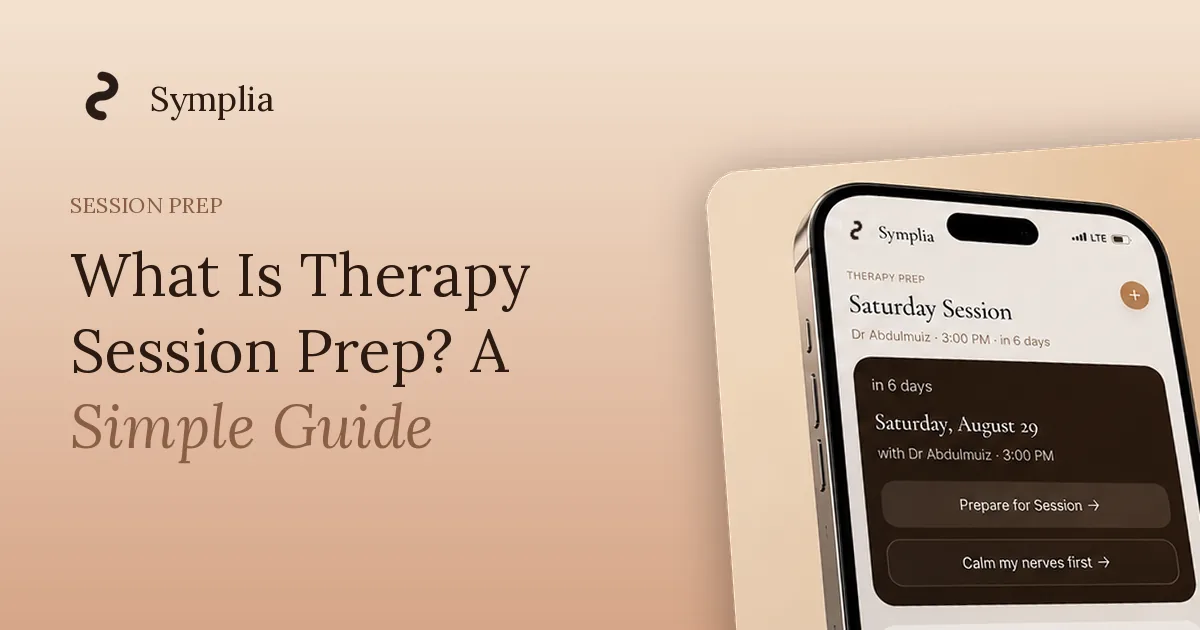
Symplia is a private mental health app for tracking, journaling, reflection and therapy support. You can log mood check-ins and journal entries through the week, then use Session Prep to gather your topics before an appointment. Therapy Work helps you keep between-session work visible, and you can choose what to share through a therapist report or a Letter to Therapist. Symplia is not therapy, a diagnostic tool or an emergency service, and it does not replace your therapist.
Try Symplia free at app.symplia.app. Monthly and Annual plans include a 7-day free trial.
Frequently asked questions
What is session prep in therapy?
It is a short note you write before a session about how you have been, what you most want to discuss, and anything your therapist should know. It helps you use your time more deliberately.
How long should session prep take?
About five to ten minutes. If it takes much longer, shorten it to your top one to three topics.
Should I show my session prep note to my therapist?
Many people read it aloud or hand it over at the start, and some use it privately as a reminder. Either is fine, and it is your choice what to share.
Do I need session prep if I already journal?
Journaling helps, but a short note that picks out your priorities is still useful. Your journal is the raw material and session prep is the summary.
Can session prep help if I struggle to open up?
It can. Writing a hard topic down beforehand sometimes makes it easier to say, and you can read the line aloud if speaking spontaneously feels difficult.
What if I forget to prepare before a session?
Spend two minutes in the waiting room or on the call jotting down how you have been and one thing you want to discuss. A small note is better than none.