To track your mental health and understand patterns over time, record the same few things at the same time each day (such as mood, sleep and energy), add one line of context about what was happening, and review the whole picture once a week or once a month. A single score tells you very little. The pattern across weeks, set next to what was going on in your life, is what makes tracking useful.
This guide explains what to track, how to keep it simple, how to read what you collect without over-reading it, and how to bring it to therapy.
Why tracking helps at all
Memory is a poor record of how you have felt. When you look back at a hard week, you tend to remember the worst moment and the most recent one. Good days fade. That makes it difficult to answer questions like "Has this been getting better or worse?" or "Is this connected to my sleep, my workload, or something else?"
A simple record gives you something outside your head to look at. It does not diagnose anything, and it does not need to be exact. Its job is to help you notice what keeps showing up, and to give you and a professional something concrete to talk about.
What to track
Start with fewer things than you think you need. Three to five is plenty.
Mood. A simple scale or a few words such as calm, anxious, low, irritable or content. Use whatever you will actually keep doing.
Sleep. Roughly how many hours and how rested you felt. Sleep often shapes mood and vice versa.
Energy. Whether you felt drained or lively. Energy and mood do not always move together, and the difference can be informative.
Context. One line on what was happening, such as a hard meeting, a long day, time with friends, or a skipped meal. This is the part most people leave out and it is the most valuable.
Things you are working on. If you are in therapy, this might be a habit, a thought pattern, or something you agreed to try. If a doctor or therapist has asked you to watch something specific, track that.
You do not need to track everything. Choose what is relevant to your situation and leave the rest.
A simple method that lasts
Tracking works when it is small. Here is a four-step approach.
1. Pick your few things. Write them down so you do not keep changing them. Changing the measures every week makes patterns impossible to see.
2. Check in at the same time each day. Evenings often work well. Thirty seconds is enough. A reminder on your phone helps.
3. Add one line of context. Write what happened, not what you think it means. "Presentation at work, slept badly" is more useful than "bad day because I am anxious."
4. Review on a schedule. Once a week, spend five minutes reading the last seven days. Once a month, look at the whole month. Without a review, you are only collecting data.
How to read your patterns without over-reading them
When you look back, ask a few plain questions:
- What days were highest and lowest, and what was happening on them?
- Does a low mood tend to follow poor sleep, or the other way around?
- Are there days of the week, times of the month, or situations that repeat?
- What did I do on better days that I did not do on worse ones?
- Is anything different from three months ago?
A few cautions are worth keeping in mind.
Patterns are clues, not proof. If your mood dipped on three Mondays, that is worth noticing. It does not prove Mondays are the cause. Treat what you find as something to explore, not a conclusion.
Do not chase a perfect line. Mood rises and falls for many reasons. A bad stretch is not a failure of tracking, and a flat line is not necessarily a good sign.
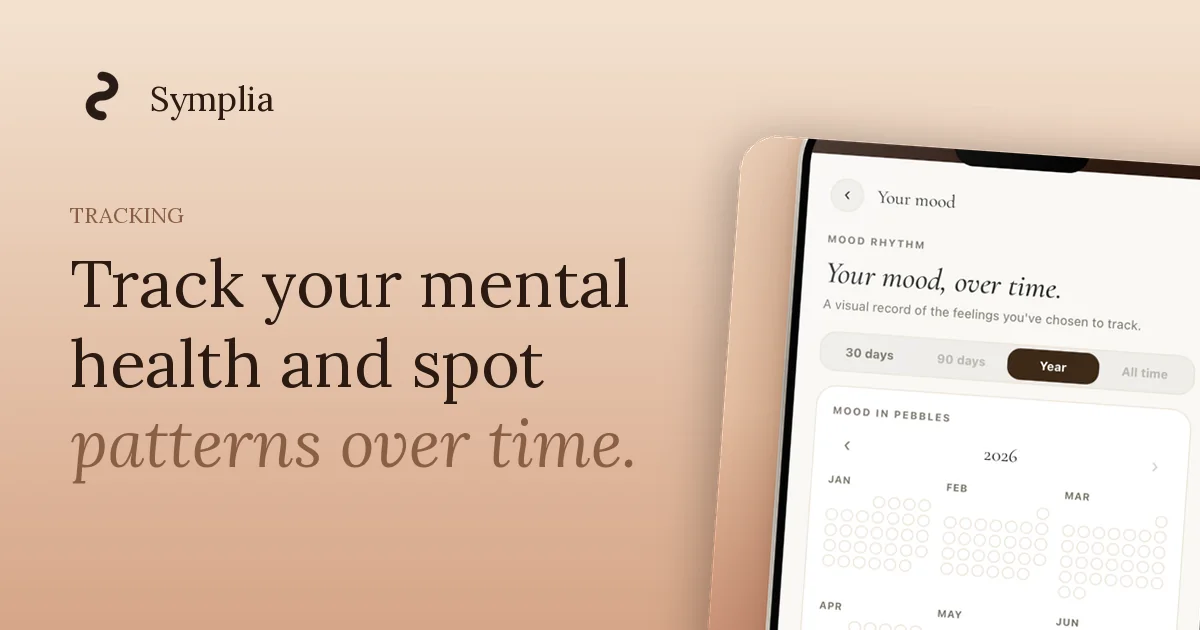
Look at the long view. A single day matters less than the shape of a month or a year. That is why visual summaries, such as a year of daily moods shown at a glance, can help you see changes you would otherwise miss.
Pair numbers with words
A number alone does not tell you much. A "4" could mean a quiet, tired day or a painful one. A short note next to it gives the number meaning, and that is where journaling and tracking work well together. If you want more on the writing side, see our guide to the mental health journal and our list of journal prompts.
Common mistakes
- Tracking too many things. You stop after a week. Start small.
- Skipping the context. Without it, you cannot explain your own data later.
- Only tracking bad days. Include good days, otherwise the picture is skewed.
- Never reviewing. The review is where the value is.
- Judging yourself by it. The record is information, not a score on you.
When tracking stops helping
For most people tracking is a calm, useful habit. For some it can become a source of pressure. Signs it may not be helping include checking obsessively, feeling worse after logging, or feeling guilty about missed days. If that happens, reduce what you track, track less often, or take a break. If you notice it increasing your anxiety, it is worth mentioning to a therapist or doctor.
Tracking is not a substitute for professional care. If you are struggling, please reach out to a licensed professional or a local crisis service.
Bringing your tracking to therapy
If you are in therapy, your record can save time and add detail. You do not need to bring every entry. A short summary is usually more helpful:
- how your mood has moved over the last few weeks
- anything that repeated, such as certain situations or times of day
- changes in sleep or energy
- one or two entries that stood out
Your therapist can then help you interpret what you have noticed. For ways to carry the work across the week, see how to track your mood between therapy sessions and our page on the therapy tracker.
Where Symplia fits
Symplia is a private mental health app that brings mood check-ins, journaling and therapy preparation into one place. You can record how you feel and the context you choose to keep, look back over your history, including a year-at-a-glance view, and use insights to notice recurring themes. Insights are not a diagnosis, and Symplia does not replace therapy or a licensed professional. You decide what to share. You can read more about the mental health tracker.
Try Symplia free at app.symplia.app. Monthly and Annual plans include a 7-day free trial.
Frequently asked questions
How do I track my mental health?
Choose three to five things such as mood, sleep, energy and a line of context, record them at the same time each day, and review them weekly or monthly. Keeping it small is what makes it last.
How often should I track my mood?
Once a day is enough for most people. Pick a consistent time, such as the evening, so the entries are comparable.
What should I write in a mood journal?
A mood word or score, roughly how you slept, and one line about what was happening. Add a few sentences when something significant occurs.
How long does it take to see patterns?
Often a few weeks gives some early clues, and a few months gives a clearer picture. Longer records are more reliable than short ones.
Is mood tracking the same as therapy?
No. Tracking gives you information about yourself. Therapy involves working with a trained professional. Tracking can make therapy more useful, but it does not replace it.
Can tracking make anxiety worse?
For some people, yes, especially if it becomes obsessive. If it does, simplify what you track, track less often, or pause, and consider talking to a professional.