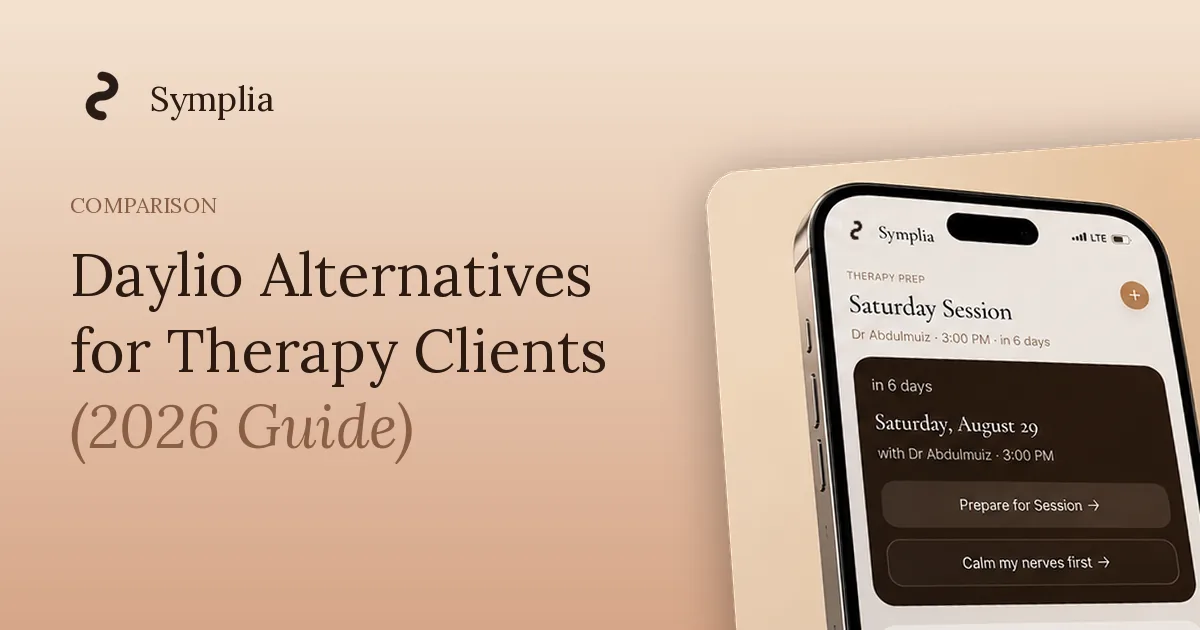
If you are in therapy and Daylio no longer feels like enough, the best alternative depends on what is missing. Bearable suits people who want detailed health correlations, Day One suits people who want a rich private journal, and Symplia suits people who want tracking tied to therapy sessions: session prep, a shareable therapist report and post-session reflection. Daylio is still a good fast mood diary. The question is whether it fits how you use therapy.
This guide covers what Daylio does well, where therapy clients tend to outgrow it, and how to choose a replacement without switching apps every month.
What Daylio does well
Daylio's own site describes it as a mood diary and habit tracker where you can "create a daily entry in two taps", picking a mood and activities. You can add notes, photos and voice memos, view entries in a list or calendar, and see charts that include mood trends and correlations. It also offers a Year in Pixels view, reminders, goals, PDF and CSV export, and PIN, fingerprint or Face ID lock. The site says it does not send your entries to its servers.
That is a lot of value for something quick. If your therapist asked you to "rate your mood each day" and you do exactly that, Daylio may be all you need. Pricing for its Premium tier is best checked on their site.
Where therapy clients often outgrow it
Daylio is a general mood and habit tracker. From what its site describes, it is not built around the therapy relationship. That is not a flaw, but it leaves gaps that therapy clients commonly notice:
- No session prep. You can have weeks of data and still sit down in the waiting room unsure what to say. Turning data into an agenda is manual work.
- Short entries by design. Two taps are fast, but a mood face and a few activity tags rarely capture the thought that actually mattered.
- Nothing connected to what you are working on. Your therapist might have given you a thinking exercise or a goal. A general tracker does not know that.
- No post-session reflection. Insight fades quickly after an appointment, and there is usually no dedicated place to catch it.
If you recognise two or three of these, you are probably not looking for a better mood tracker. You are looking for a tool that connects tracking to sessions. Our Symplia vs Daylio comparison goes through that difference in more detail.
Alternatives worth considering
Bearable: for detailed health patterns
Bearable's site lists mood, emotions, sleep, symptoms and energy among the things you can track, along with medication, activity and other health measures, plus correlation reports and the ability to export data for doctor visits. It has a free tier and a paid subscription, so check their site for current prices. It is available on iOS and Android.
Best for: people managing sleep, chronic symptoms, ADHD or medication alongside therapy, who want to see how factors interact. Trade-off: more setup and more data points can feel heavy if you are already low on energy.
Day One: for private, flexible journaling
Day One is a journaling app rather than a mood tracker. Its site describes photos, video and audio in entries, "On This Day" reminders of past entries, passcode and biometric protection, end-to-end encryption and export. It runs on iPhone, Android, iPad, Mac, the web and more, and has a free tier with a paid Gold plan.
Best for: people who want a beautiful, flexible journal and are happy to write freely. Trade-off: it is not designed around therapy, so there is no structured session prep or mood-to-therapy workflow.
Symplia: for tracking tied to therapy
Symplia is a private mental health app for tracking, journaling and therapy support. Mood check-ins include context, so a low score is paired with what was going on. The journal supports free-writing, prompts, Voice Journal, Unsent Letters and Thinking Traps. Session Prep helps you turn the week into what you want to raise, Therapy Work keeps track of what you are practising between appointments, and you can create a shareable therapist report where you choose what to include. AI-assisted insights help you notice recurring themes. They are not a diagnosis.
Best for: people who see a therapist regularly and want their tracking to feed their sessions. Trade-off: it does more than a simple mood diary, so it is heavier than a two-tap check-in if that is all you want. It is a web app today, with iOS and Android coming soon.
How to choose
Ask yourself three questions:
- What do I want to do with the data? If the answer is "bring it to therapy", look for session prep and sharing, not just charts.
- How much effort can I keep up on a bad week? The best app is the one you still open when you are struggling.
- How private does it need to be? Look at how each app handles locks, backups and sharing, and read the privacy policy.
If you are not sure, run a two-week test. Track in your current app and in one alternative, then notice which one made your last session easier to start. Our guide on how to track mood between therapy sessions has a simple routine you can use, and the mental health tracker page explains what to record.
Make the switch easier
- Export what you can from your old app (Daylio supports PDF and CSV) so you keep your history.
- Do not try to copy every past entry. Bring over the patterns you noticed instead.
- Tell your therapist you changed tools and what you want them to see.
When to get support
A tracker can show you patterns, but it cannot respond to a crisis. If your mood is dropping, you are thinking about harming yourself, or you feel unsafe, contact a licensed mental health professional, your local emergency services or a crisis line in your country.
Where Symplia fits
Symplia is not a replacement for therapy or a diagnostic tool. It is a private place to record your week, notice patterns and prepare what you want to say, so sessions begin with substance. Every plan includes every feature; you can see the options on the pricing page.
Try Symplia free at app.symplia.app. Monthly and Annual plans include a 7-day free trial.
Frequently asked questions
Is there a free alternative to Daylio?
Several apps have free tiers, including Bearable and Day One, though what is included changes, so check each site. Free tiers usually limit history, reports or sync.
What is the best Daylio alternative for therapy?
It depends on your goal. For tracking that connects to sessions, a therapy-focused app such as Symplia fits best; for detailed health correlations, Bearable; for free-form journaling, Day One.
Can I show Daylio data to my therapist?
Yes. Daylio's site says you can export entries as PDF or CSV, and you can also screenshot charts. A short note about what stood out is usually more useful than raw data.
Should I stop using Daylio if it works for me?
No. If it is easy and you use it consistently, keep it. Switch only if you find yourself unable to turn the data into something useful in sessions.
Will my therapist mind which app I use?
Most therapists care more that you reflect between sessions than which tool you use. Ask them what they would find helpful to see.
Are mood tracking apps a substitute for therapy?
No. They can help you notice patterns and prepare, but they do not replace care from a licensed professional.