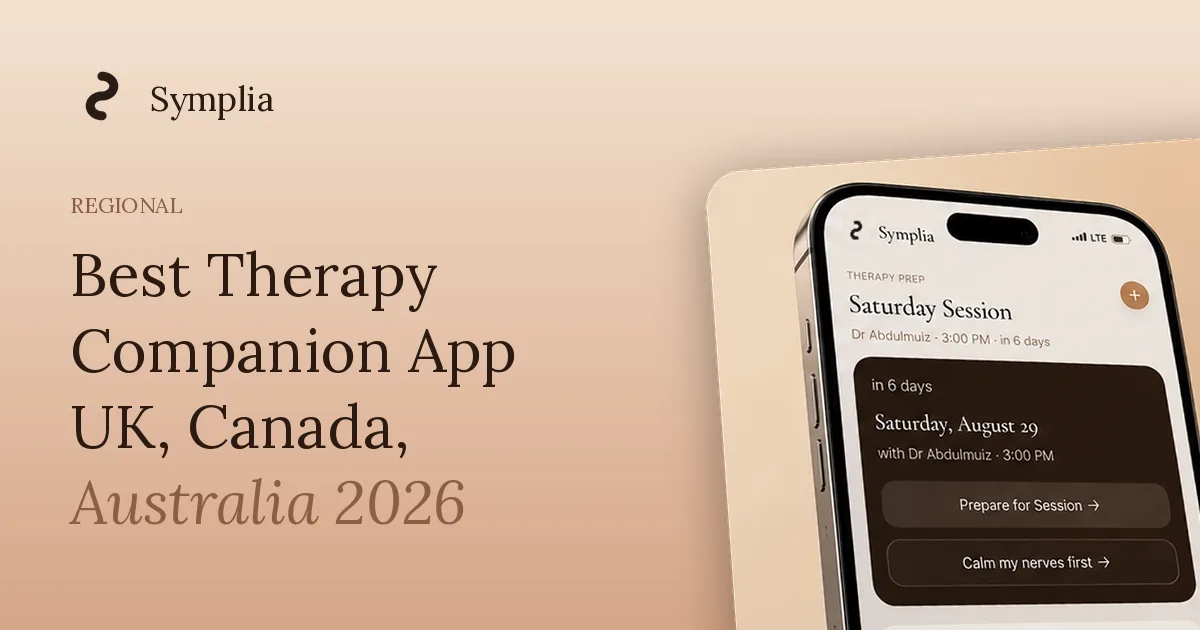
The best therapy companion app in the UK, Canada and Australia is one that supports the therapy you already have: private journaling, mood tracking, session prep and a clear way to share notes with your therapist. Because privacy law and therapy access differ by country, check where your data goes and read the privacy policy before you start. As of October 2026, here is how to choose, plus how therapy access works in each country.
What a therapy companion app does
A therapy companion app helps you between sessions. You capture moods, triggers and thoughts while they are fresh, then bring a clear picture to your appointment. It is not therapy, and it does not replace a therapist or a doctor. If the idea is new to you, what a therapy companion app is covers the basics.
The same features matter in every country:
- Journaling with prompts or voice, so you can start quickly.
- Mood check-ins with a note on context.
- Session prep, so you walk in with the points that matter. See therapy session prep.
- Sharing you control, so you decide what your therapist sees.
- Clear privacy and pricing, in plain language.
The United Kingdom
How people typically access therapy
According to the NHS, adults can refer themselves to NHS Talking Therapies for problems such as anxiety, depression, phobias, OCD and PTSD without seeing a GP first. You need to be registered with a GP and aged 18 or over (16 or over in some areas). The NHS describes these services as free. Some conditions, such as eating disorders, bipolar disorder, psychosis or drug and alcohol problems, need a GP referral to a specialist instead. Private therapy is paid for directly, and some employers, universities and charities offer it at no cost.
If you are waiting for NHS therapy or already in it, an app can help you track how you feel and prepare for sessions in the meantime.
Privacy: UK GDPR
Under the UK GDPR, the Information Commissioner's Office (ICO) describes health data as special category data, which needs more protection because it is sensitive. Organisations handling it must meet extra legal conditions and be transparent in their privacy information. For you, that means a mental health app should explain clearly what it collects, why, and how you can access or delete it. It is reasonable to ask.
Canada
How people typically access therapy
Access varies by province and territory. The Centre for Addiction and Mental Health (CAMH) in Ontario notes that psychotherapy from a psychiatrist or other medical doctor is covered by provincial health plans, while psychologists' fees are not covered by most provincial health plans, though their services may be free in government-funded hospitals, clinics or agencies. Private practice therapy is usually charged as a fee, and some therapists offer sliding scales. Extended health plans, employee assistance programs and school or university counselling may help with cost. Because rules differ across provinces, check with your own provincial health ministry or a local provider.
Waits and costs are part of why many people use an app between appointments, or while looking for a therapist. Our therapy cost calculator can help you plan a budget.
Privacy: PIPEDA
The Office of the Privacy Commissioner of Canada explains that, under PIPEDA, organisations should collect, use or disclose your information with your consent and only for purposes that are stated and reasonable. You can generally ask to see the personal information an organisation holds about you and ask for corrections. If you are not satisfied after raising a concern with the organisation, you can complain to the Privacy Commissioner. Some provinces and some kinds of organisations are covered by other laws, so this is a starting point, not legal advice.
Australia
How people typically access therapy
The Australian Government's Better Access initiative provides Medicare rebates for mental health services. According to the Department of Health, you need a valid referral, usually a Mental Health Treatment Plan from a GP or other prescribed medical practitioner, or a direct referral from a psychiatrist or paediatrician. Eligible patients can receive up to 10 individual and up to 10 group mental health treatment services per calendar year. Practitioners set their own fees and are not required to bulk bill, so you may pay a gap above the Medicare benefit.
Ask your GP what applies to you. If you are using your sessions across a calendar year, an app can help you decide what to focus on in each one.
Privacy: the Privacy Act 1988
The Office of the Australian Information Commissioner (OAIC) says the Privacy Act 1988 promotes and protects the privacy of individuals and includes 13 Australian Privacy Principles. It covers Australian Government agencies and organisations with an annual turnover above $3 million, plus some other organisations. Not every business is covered, so it is worth asking an app how it handles your data regardless of its size.
How to choose an app, wherever you live
- Read the privacy policy. Look for what is collected, who it is shared with, and how to delete your data.
- Ask where data is stored. If you cannot find an answer, email the company.
- Check what you can share. You should control what reaches your therapist.
- Look at pricing and trials. Confirm the renewal period and how to cancel. Prices are often shown in US dollars, so check the conversion.
- Be wary of cure claims. No app can promise results.
- Pair it with real care. Use the app to support therapy, not replace it.
Where Symplia fits
Symplia is a private mental health app for tracking, journaling and reflection that is built to support therapy. It offers a journal with prompts, Voice Journal and Unsent Letters, mood check-ins, Session Prep, Therapy Work and a shareable therapist report. Its AI-assisted insights help you notice recurring themes and are not a diagnosis. Symplia is not therapy and not an emergency service. It is available as a web app at app.symplia.app, with iOS and Android coming soon. We make no claims here about legal compliance in any country, so please read the privacy policy and email hello@contact.symplia.app with questions about how your data is handled. For plans, see pricing (USD). Monthly and Annual plans include a 7-day free trial.
Try Symplia free at app.symplia.app
When to get support
If you are in distress or having thoughts of harming yourself, contact a licensed professional, your local emergency services or a crisis line in your country right away. A companion app is not an emergency service.
Frequently asked questions
Is there a therapy companion app that works in the UK, Canada and Australia?
Most web and mobile apps can be used in all three countries, but they differ in privacy terms, pricing and features. Check the privacy policy and trial terms before you decide.
Can I use an app while I wait for NHS therapy?
Many people do. An app can help you track your mood and prepare for sessions, but it does not replace treatment, so speak to your GP if you need support sooner.
Does my therapist need to use the same app?
No. With Symplia, you choose what to share from your own account, for example in a therapist report. Ask your therapist how they prefer to receive it, and see our guide to sharing notes with your therapist.
Is Symplia compliant with UK GDPR, PIPEDA or the Australian Privacy Act?
We do not make legal-compliance claims on this page. Please read the privacy policy and email hello@contact.symplia.app with specific questions.
How much does Symplia cost?
Weekly is $4.99 with no trial, Monthly is $12.99 and Annual is $79, with a 7-day free trial on Monthly and Annual. Prices are in USD and every plan includes every feature.
Can an app replace seeing a therapist?
No. Apps can support the time between sessions, but they are not therapy or diagnosis.