The best therapy companion app for anxiety is one that helps you notice worry loops, track triggers, and bring clear patterns back to your therapist, without replacing them. Look for fast journaling, thought-record style reflection, mood and trigger tracking, session prep, and a way to practise what you learn between appointments. Symplia is one option built around those things, but any app is a support tool, not treatment.
Why anxiety needs more than a mood diary
Anxiety rarely stays inside your weekly session. It shows up at 11pm before a big day, in the middle of a meeting, or in the twenty minutes before sleep. By the time you see your therapist, the details are often blurry: what set it off, what you told yourself, what you did next.
A companion app can help close that gap. Done well, it gives you a place to capture what happened while it is fresh, and a record you can bring to your next session. If you are new to the idea, what a therapy companion app is explains the basics.
Features that tend to help when you are in therapy for anxiety
Journaling that catches worry loops
Worry often repeats the same story in slightly different words. Writing it down can help you see the loop from the outside. Look for an app that makes free-writing quick, offers prompts for when your mind is racing, and ideally lets you speak instead of type when you are too wound up to write. If you want ideas, try these anxiety journal prompts or the wider set of journal prompts.
Thought-record style reflection
Many therapists use cognitive behavioural approaches that involve looking at a worrying thought, the evidence for and against it, and a more balanced alternative. A good app can guide you through a short version of this, for example by pointing out common thinking traps such as catastrophising or mind reading. It should support the work you are doing with your therapist, not invent a new method.
Mood and trigger tracking
A quick check-in with a note on context (where you were, who you were with, how you slept) can show patterns that are hard to see day to day. Maybe Sunday evenings are worse, or the lead-up to certain meetings. Keep it light. If tracking takes more than a minute, you will stop. For more on this, see how to track your mood between therapy sessions and the mental health tracker page.
Session prep
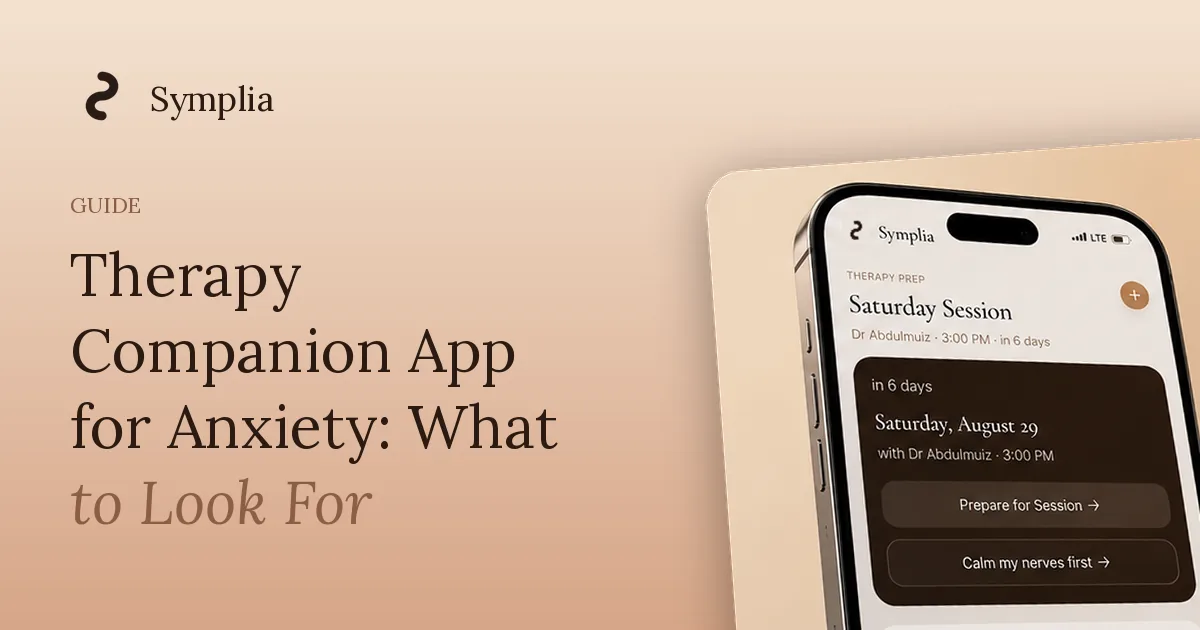
Anxious people often leave a session realising they forgot the thing that mattered most. Session prep means jotting down what you want to cover as it comes up during the week, so you walk in with a short list. Our guide to therapy session prep shows how this works in practice.
Between-session practice
If your therapist gives you exercises, such as exposure steps, breathing practice or worry time, an app can help you remember them and note how they went. The note "I tried it, it was harder than expected" is useful information for your next session.
How to choose
Ask these questions before you commit:
- Is it quick to open and use when you are anxious? A long setup will not survive a bad night.
- Does it help you reflect, or only distract? Calming content has its place, but reflection is what carries into therapy.
- Can you share what you choose with your therapist? A summary you control is better than trying to remember a fortnight.
- Is the privacy policy readable? You are storing sensitive thoughts. Read what is collected and how you can delete it.
- Is the pricing clear? Check the trial terms, the renewal period and how to cancel before you enter payment details.
- Does it say what it is not? Honest apps state that they are not therapy or an emergency service.
What to avoid
- Apps that promise to cure anxiety. No app can promise that, and claims like that are a red flag.
- Features that encourage checking compulsively. If tracking makes you more anxious, scale it back and tell your therapist.
- Streak pressure. Guilt about a missed day is the last thing an anxious mind needs.
- Vague privacy terms. If you cannot tell who sees your entries, look elsewhere.
- Using an app instead of care. If anxiety is affecting your sleep, work or relationships, professional support matters more than any app.
Where Symplia fits
Symplia is a private mental health app for tracking, journaling and reflection that is built to support therapy. It includes a journal with prompts, Voice Journal and Thinking Traps, mood check-ins with context, Session Prep, Therapy Work, and a shareable therapist report where you choose what to share. Its AI-assisted insights help you notice recurring themes; they are not a diagnosis. Symplia is not therapy and not an emergency service. It is a web app at app.symplia.app for now, with iOS and Android coming soon. Plans are listed on the pricing page, and you can read how data is handled in the privacy policy. Monthly and Annual plans include a 7-day free trial.
Try Symplia free at app.symplia.app
When to get support
If anxiety feels unmanageable, or you are having thoughts of harming yourself, contact a licensed professional, your local emergency services or a crisis line in your country right away. An app is not the right tool for an emergency.
Frequently asked questions
What is the best therapy companion app for anxiety?
The best one is the one you will actually use, and that supports reflection, tracking and session prep. Compare features, privacy and pricing against what your therapist suggests rather than picking by rating alone.
Can an app replace therapy for anxiety?
No. Apps can support the work between sessions, but they do not replace a licensed professional, especially when anxiety affects daily life.
Is journaling good for anxiety?
Many people find that writing out worries helps them see patterns and calm racing thoughts. It works best alongside professional support if your anxiety is persistent.
Should I show my therapist what I track?
Many therapists welcome it, since it gives them specifics instead of a vague recap. Choose what you share, and ask your therapist how they like to receive it.
Does Symplia diagnose anxiety?
No. Symplia is not diagnostic. Its insights help you notice recurring themes so you can discuss them with a professional.
How much does Symplia cost?
Weekly is $4.99 with no trial, Monthly is $12.99 and Annual is $79, with a 7-day free trial on Monthly and Annual. Every plan includes every feature, and prices are in USD.